
The Maldives' Most Committed Eco-Friendly Resort
Why Banyan Tree Vabbinfaru Goes Further
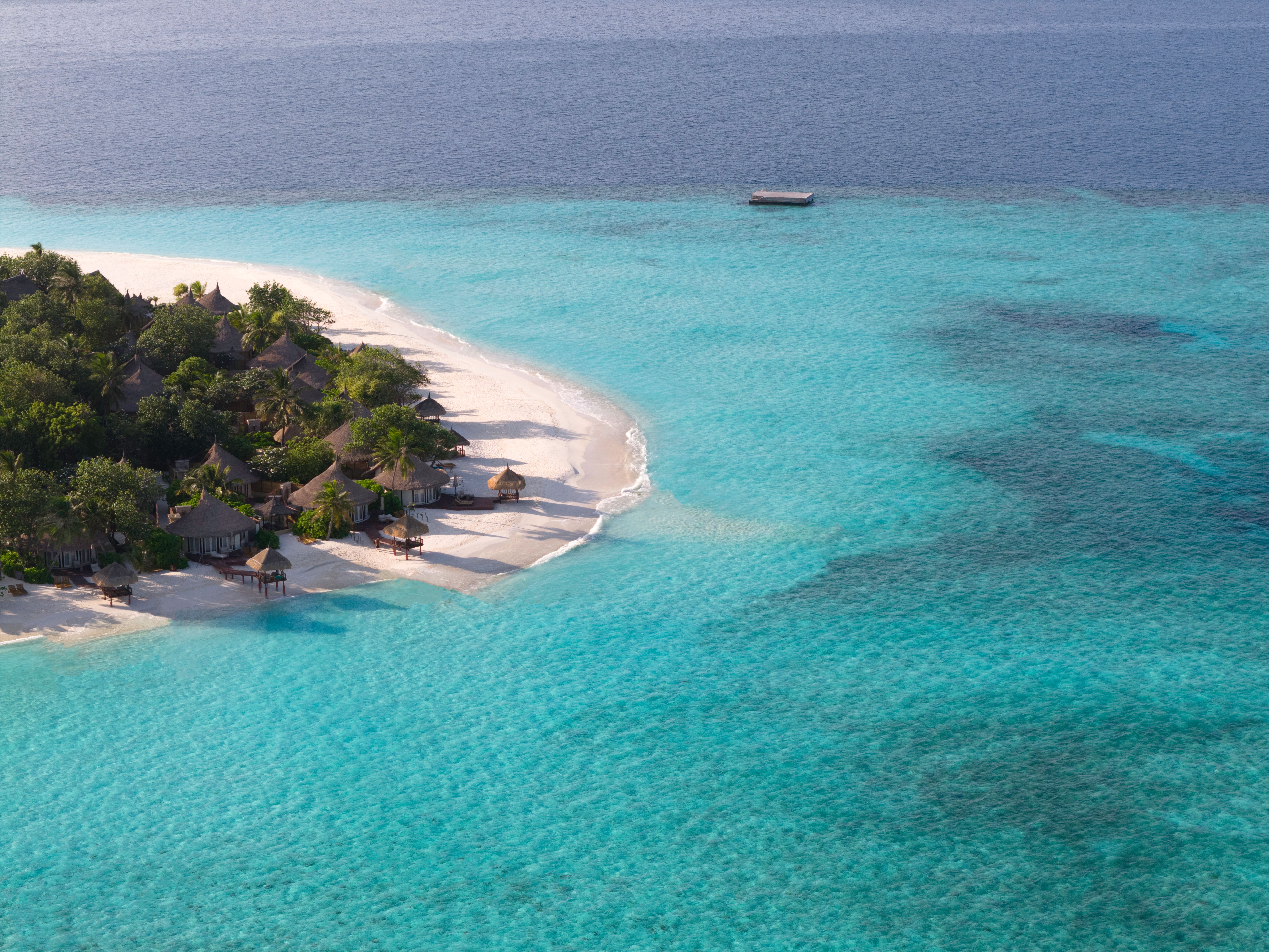
The Maldives has become synonymous with pristine beauty. But how many resorts are genuinely protecting that beauty - and how many are simply calling themselves eco-friendly because it sells? At Banyan Tree Vabbinfaru, sustainability is not a marketing position. It is a 30-year operational commitment built on a working marine research facility, measurable conservation outcomes, and a pioneering island management philosophy when the resort opened in 1995.
This article examines what truly separates Vabbinfaru from the growth of eco-branded luxury resorts in the Maldives — and why that difference matters for travellers who want their stay to leave the reef just as pristine as they found it.
Why Most 'Eco-Friendly' Claims in the Maldives Are Incomplete
Sustainability has become the most overused — and underdefined — word in luxury travel. Solar panels on the roof, a recycling station near reception, and a pledge to reduce single-use plastics: these are the baseline. They are table stakes, not differentiation.
The Maldives, as an archipelago uniquely threatened by rising sea levels and coral bleaching, demands more from the resorts itself. The reefs that form the foundation of the entire tourism economy are under documented, accelerating stress. In that context, a resort's relationship with its marine environment is not a side programme — it is the central responsibility.
Banyan Tree Vabbinfaru was built on this premise from day one. The result is a depth of environmental integration that cannot be replicated overnight by resorts newly embracing eco-conscious design.
The Marine Lab: Over Twenty Years of Reef Restoration With Measurable Results
In 2004, Banyan Tree Vabbinfaru established the first resort-based marine research facility in the Maldives — the Banyan Tree Maldives Marine Lab. At the time, it was the first-of-its-kind in the Maldives: a working scientific facility founded within a luxury resort, with its own resident marine biologists, with research outcomes supporting directly reef conservation policy.
That facility is now in its third decade of operation. Following the late 2024 renovation of the resort — which coincided with Banyan Group's 30th anniversary — the Marine Lab was expanded and its research programmes deepened. The house reef surrounding the island is one of the most intact in the North Malé Atoll, a direct outcome of more than two decades of active management.
What Our Marine Lab actually does:
The team conducts ongoing coral health monitoring, runs an active coral propagation and replanting programme, and collects longitudinal data on species diversity and bleaching events. Guests are invited to participate directly — planting coral fragments under the guidance of the resident marine biologists, and becoming part of the documented restoration record.
For the traveller who asks not just 'is this reef beautiful?' but 'will this reef exist in ten years?', Vabbinfaru offers something no other resort in the Maldives can match: twenty-plus years of continuous data, and a programme that has demonstrably slowed reef degradation on its island.
EarthCheck Certification and the TTM Most Sustainable Resort Award
Sustainability claims require independent verification. Banyan Tree Vabbinfaru holds EarthCheck certification — the world's leading science-based certification programme for travel and tourism. EarthCheck does not evaluate intent or marketing language. It measures energy consumption, water use, waste diversion rates, carbon intensity, and community contribution against benchmarks that evolve annually.
In 2024, Vabbinfaru received the Most Sustainable Resort award at the Travel Trade Maldives (TTM) Awards, and in 2025, was recognized as the Leading Eco-Friendly resort by South Asia Awards (SATA Awards),recognition from industry peers in regional area, where the standards of comparison are understood precisely. The same year, Banyan Group received Most Influential Sustainable Development Group of the Year at the 2025 GO Travel Awards, extending the credential from property to parent organisation.
At a group level, Banyan Tree's sustainability record spans over three decades: the Green Imperative Fund, established in 2001 to formalise environmental commitments; alignment with the UN Sustainable Development Goals since 2017; and the Brand for Good framework, which requires 91 operating hotels to report monthly on 40 specific environmental guidelines. As of 2024, 86% of the hotel portfolio is compliant — a number tracked and published in the group's annual sustainability report.
These are not aspirational statements. They are audited, reported, and comparable across years.
The House Reef: Snorkelling an Intact Ecosystem
Vabbinfaru's house reef is its most immediate and visceral proof of environmental commitment. Unlike many Maldives properties where house reef access is challenging — a shallow sandy drop-off offering occasional fish sightings — the reef at Vabbinfaru is an active, healthy, biodiverse ecosystem that guests can enter within minutes of from the shore.
The reef supports documented populations of blacktip and whitetip reef sharks, sea turtles, eagle rays, and hundreds of reef fish species.
For the eco-conscious traveller, this is the difference between reading about marine conservation and experiencing it. The reef is not a backdrop to a luxury stay; it is the stay's central character.
The resort's deliberate choice not to build overwater villas — which would require seabed piling and cause permanent reef damage — is an architectural sustainability decision that most resorts in the Maldives have not made. At Vabbinfaru, all 48 villas are beachfront pool villas, positioned on the island and constructed with sustainably sourced materials. The reef remains uncompromised beneath the surface.
Sustainable Dining: From Sangu Garden to Responsible Sourcing
Vabbinfaru's 2024 renovation introduced Sangu Garden — a unique dining concept built around a self-caught grill, where guests participate in responsible line fishing in the surrounding waters and bring their catch directly to the kitchen. The concept is grounded in sustainable fishing practices,, and entirely foreign to the all-inclusive food-factory model that defines much of Maldives resort dining.
Across the resort's five dining outlets — including Saffron and award-winning overwater Madi Hiyaa, the kitchens operate under the group's sustainable food sourcing guidelines: 15% of seafood purchases from certified sustainable sources, a target that increased from 7% in 2022 and continues to grow.
This is F&B as environmental action, not merely F&B as lifestyle experience.
What Genuine Eco-Luxury Looks Like at Vabbinfaru
True sustainability in luxury hospitality goes beyond a checklist. It is a design philosophy that informs every element of an eco luxury resort - from villa design to marine conservation research and sustainable sourcing. At Banyan Tree Vabbinfaru, that philosophy has guided operations since 1994.
The differentiators — for a traveller comparing eco-friendly resort options in the Maldives — are as follows:
- Home to one of the Maldives’ pioneering resort-based marine lab, with over 20 years of continuous reef monitoring and longitudinal data.
- EarthCheck certified — independently audited environmental performance.
- TTM Most Sustainable Resort 2024 — peer-verified industry recognition within the Maldives.
- No overwater villas — a deliberate conscious design decision to safeguard the reef and preserve the seabed below.
- 48 beachfront pool villas fully renovated in 2024 using sustainably sourced materials.
- Active weekly coral planting programme — guests participate as citizen scientists, not spectators.
- One of the most vibrant thriving house reefs in the North Malé Atoll. Sustainable sourcing across five
- F&B outlets including a self-caught grill concept.
For a resort that opened its doors in 1995, the sustainability story is not a recent rebranding exercise. It is the original story — the reason the Marine Lab exists, the reason the reef is still healthy, and the reason Vabbinfaru calls itself the Original Maldives.
{#}
Experience the Maldives' Original Eco-Luxury Resort
Banyan Tree Vabbinfaru offers 48 all-pool beachfront villas, a resident marine biologist team, direct house reef access, and three restaurants including the award-winning Madi Hiyaa. Speedboat transfer from Malé International Airport takes approximately 25 minutes — one of the shortest transfers to any luxury eco-friendly resort in the Maldives.
To explore availability and seasonal marine conservation experiences, visit the Banyan Tree Vabbinfaru resort page or contact the reservations team directly.