
Wahehe: The Rhythm of Land and Memory
Wahehe: The Rhythm of Land and Memory
The Ruaha mornings arrive without ceremony. The air is heavy with the scent of warmed earth, and the horizon holds a quiet red, clay and dust, and the first light dissolving into it. Near the Great Ruaha River, the land lies open and unguarded, a body breathing in rhythm with the wind. At Ubuyu, a Banyan Tree Escape, the wilderness does not perform; it listens. Each ridge, each tree, each echo of water feels aware of itself, as if the world here remembers what it once was.
An hour from the Ruaha National Park’s edge, Tungamalenga unfolds in slow, terracotta slopes. This is the heartland of the Wahehe, whose lineage runs as deep as the roots of the ubuyu tree. The Wahehe trace their origins to the southern highlands of Tanzania, where scattered Bantu-speaking clans once gathered under shared customs of cultivation and defense. By the eighteenth century, these clans had begun to identify collectively through kinship, land, and the sound that became their name; he…he, a war cry once called across hills to rally allies in battle. Over time, that echo evolved from signal to identity, binding families through rhythm and memory. Their homeland, centred around Iringa and the Ruaha basin, grew known for its order, resilience, and grace in adversity. After independence, the Tanzanian government formally recognised the Wahehe as one of the nation’s distinct ethnic groups, their name interlaced with Iringa’s civic and cultural identity. Today, they remain central to the region’s social life, a people who carry the composure of warriors yet speak most fluently through kinship, cultivation, and quiet continuity.
The Ruaha basin teaches through contrast. Its soils are dense with memory, its air holds the residue of storms. Baobabs, or ubuyu, rise like sentinels, wide-limbed and watchful. Between them the wind moves with intent, carrying the murmur of reeds, the chatter of guinea fowl, and the faint throb of a distant drum. For the Wahehe, such sounds are instruction. The land is not backdrop but teacher. Each act of planting, harvesting, or pounding grain follows its pulse. The rhythm of work becomes the rhythm of worship. Their gestures hold precision shaped by endurance, the patience of those who read the world not by clock or calendar but by the weight of light, by the scent that precedes rain.
They live within what others might call purity, the unbroken attention of a people who have never separated life from the land that holds it.
Their stories carry a quiet strength. In the late nineteenth century, when the winds of foreign conquest reached these highlands, the Wahehe met them not with fear but with composure. Led by Chief Mkwawa, they turned to the landscape for counsel. Valleys concealed their paths, ridges became signal towers, the river their messenger. What endures from that time is not the memory of conflict, but of clarity, an understanding that to defend one’s home is to protect the harmony between people and place. The Hehe spirit has always been one of balance. Even resistance was an act of remembering, a vow to keep the land and its voice intact.
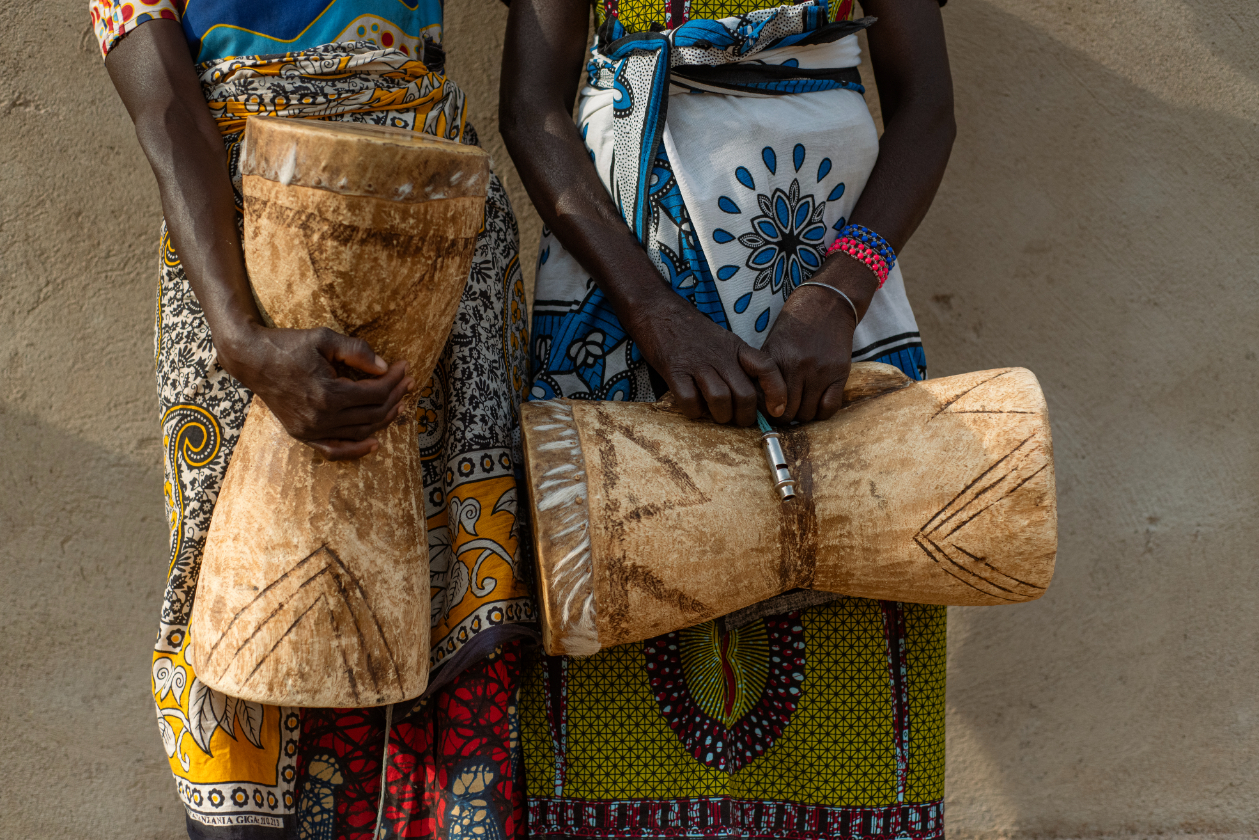
In the villages near Mangalali, evening begins with a pulse. A single drumbeat, slow and certain, followed by a voice, then feet striking dust. The dancers move in a circle, bells tied to their ankles, voices rising and falling like wind through dry grass. Someone taps rhythm on a stool, another claps, another calls. Nothing repeats, yet nothing strays. The rhythm builds, dissolves, and returns.
They do not dance to escape. They dance to arrive, to place themselves once again within the pattern of life. Movement becomes memory made visible. In the dust that rises beneath their feet are the faint prints of those who came before, a continuity felt more than known. The dance is inheritance and invocation, a way of honouring the earth that still holds them.
In Iringa town, that same rhythm softens into the work of hands. At Neema Crafts, clay is turned, thread wound, fibre woven. Every gesture has weight, every repetition a kind of prayer. The artisans do not speak of art, yet what they make carries grace, the patience of people who live through the things they touch. Love, here, is practical. It is in the way grain is shared, in the long rhythm of greeting, in the silences that rest between words. Care is not sentiment but continuity, a way of keeping time with the land.
Among the Wahehe, the mythic remains close to the everyday. The ancestors are not distant; they move through wind and rain, through the quiet that arrives between seasons. The first thunderclap after harvest is greeted like an old friend. Before sowing, some still make offerings to the hills, murmuring to spirits whose names are half-remembered. Even as faiths have layered over one another, the instinct for reverence endures. The sacred and the ordinary still share the same ground. To plant is to pray. To walk is to listen. To sing is to return what the earth has given.
The Great Ruaha bends like a long breath, slow and deliberate, carrying the scent of rain and dust. Along its banks lie traces of earlier lives, hearthstones, fragments of clay, paths where children once ran at dusk. The rhythm of the Wahehe is not a remnant but a current, subtle and constant, like the under-beat of a drum.
Ubuyu rises lightly on this soil, shaped by its contours rather than imposed upon them. Space opens to the horizon, walls breathe, and the air itself seems part of the architecture. Here, silence is not absence but presence. The landscape is not arranged; it is allowed. What the experience offers is not spectacle but attunement, an invitation to find one’s own rhythm in a place that has never lost its own.
Night in Tungamalenga begins with sound. A drum from one compound, answered by another farther down the valley, then a chant, a laugh, a pulse that spreads until it feels as though the earth itself is breathing. The Hehe move without instruction, guided by something older than memory, both ancient and immediate. In that rhythm lies everything, endurance, devotion, the quiet insistence of belonging.
As the drums fade, the air cools and the stars gather. The silence that follows is not empty but luminous. At dawn, when you wake at Ubuyu, that silence lingers. The land feels less observed than inhabited. The morning light over the river is not merely beautiful; it is instructive. It teaches that rhythm is not a pattern to master but a state to enter.
The Wahehe have always known this. To live here is to move as the land moves, to speak when it speaks, to keep faith with its pulse. When you leave, it is not the sound of the drums you remember, but what remains after they have gone quiet, a steady hum beneath thought, the feeling that somewhere, beyond sight, the world is still keeping time.