.jpg)
Stay in a Tibetan farmhouse
Accomodations
Discover highland life at Banyan Tree Ringha, where home is a villa repurposed from genuine Tibetan-style farmhouses.
Banyan Tree Ringha is hidden in a quiet valley just outside Shangri-La City in Yunnan, China. An alpine sanctuary blanketed in pines and pasture, where wild yaks roam freely and prayer flags flutter in the wind.
By Nicholas Chrisostomou, Editor-in-Chief, The Cultured Traveller, for Banyan Tree.
The road out of Shangri-La rises gently, curling through a landscape that feels more elemental with each turn.
This far-flung part of southwestern China – close to the Tibetan border and high within Yunnan province – is steeped in tradition. As we leave the city behind, low buildings give way to highland pasture. Pockets of pine appear, then sweep into full forests. Barley fields sit folded between ridgelines. Prayer flags flicker in the breeze, their threads frayed by time. Horses graze in scattered herds. The air is noticeably thinner, but it
carries with it a quiet clarity.
I keep the window down and listen to everything as we make our way through Jian Tang Town towards the valley of Ringha, and on to Hong Po Village.
Roughly half an hour from town, we turn into a wide and open valley. The terrain shifts again – somehow it’s deeper, quieter. The road winds through clusters of homes, farmhouses, and storerooms, until we reach a pair of stupas and the understated entrance to Banyan Tree Ringha, surrounded by trees.
Apart from the two stupas – one a classic, Tibetan-style chorten on a square base, the other much more organic and layered with prayer stones – the property is refreshingly unpretentious. I am greeted by a genuinely warm and friendly welcome.
Beyond the stupas, a large and inviting two-storey Tibetan-style building combines local architectural elements with decorative flourishes that reflect the region’s rich cultural heritage. Accessed by an exterior wooden staircase, I sip strong ginger tea in a warm and cosseting lobby on the upper floor, before being whisked in a buggy to my lodgings.
The resort's timber lodges stand low and purposeful, scattered across a slope like they’ve been there since time immemorial. I soon discover that they are the true essence and beauty of the place.
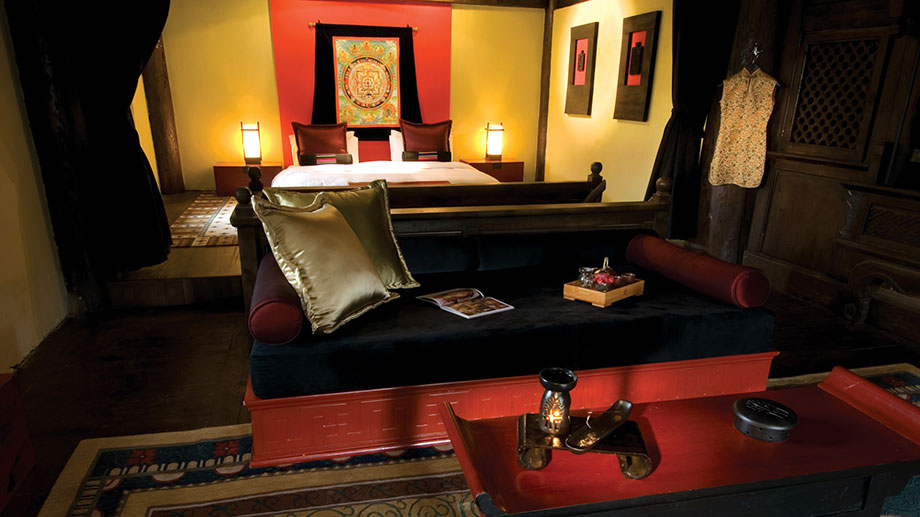
Each structure is a traditional old Tibetan farmhouse – carefully disassembled in nearby villages and lovingly reassembled here, beam by beam. My lodge is built of ancient timbers with carved lintels and polished floors. The name of the family which previous occupied it is inscribed on a weighty key fob which unlocks the entrance.
Inside, the air is still. There’s a fireplace, thick beams, heavy curtains, a massive bed, and a large bath tub downstairs. A private terrace looks directly towards the river. The Shu Du
Gang runs just beyond the edge of the property, slipping across stones in an easy, unhurried rhythm. I unpack slowly, but my urge is to sit out front, take in the panoramic vistas, and revel in the quiet.
Every morning begins on my terrace. I wrap my hands around a steaming cup of tea and sit outside in a rocking chair, watching the mist lift from the trees and the first rays of sunlight spill across the valley. Sometimes birdsong carries through the air. Sometimes it's the gentle pitter patter of rain.
Altitude has a way of slowing everything down.
My breath shortens on the stairs. Sleep comes more easily than normal. I try not to fight the change in pace, let the rhythm inside me shift, and appreciate the longer days. When the clouds pass behind the hills beyond and the sun begins to set, I think about eating. Until then, I am content to potter around my expansive yet cosy lodgings, burning incense, listening to classical music, and writing.
Two on-site restaurants are housed within another large, two-storey Tibetan-style building, which faces the valley and is fronted by an unpretentious terrace, allowing Mother Nature to remain centre stage while I sip a glass of palatable local wine. There’s no need to book a table. I arrive when I’m hungry and am met with gentle efficiency.
The food is local, seasonal, and warming – somewhat familiar yet distinctive. Everything I eat is delicious and tastes of the place it comes from. A rustic, slow-cooked stew, featuring tender braised yak meat simmered with golden potatoes in a dark, savoury sauce, is deeply satisfying. And I can't get enough of a typical Yunnan-style stir-fry of yak diced into bite-sized pieces and cooked in a wok on high-heat with leeks, onions, and mushrooms.
On the one day I venture away from Ringha for any real length of time, I travel half an hour to visit Songzanlin Monastery – an unmissable, awe-inspiring complex of gold-tipped rooftops, towering walls, and layered prayer halls, all unfolding across a vast hillside like a living thangka painting.
Grand yet grounded, it is as spiritually resonant as it is visually arresting, and without question the cultural heart of the region. But after hours spent exploring its sprawling staircases and navigating the sheer scale of the complex, I find myself longing for the protective quiet of Banyan Tree Ringha – its soft tempo, thoughtful simplicity, and the familiar comforts of my home-away-from-home.
The following day, I decide to amble along the banks of the Shu Du Gang River.
There’s no plan, just a path that follows the water. I pass sheep foraging midstream, horses grazing in highland meadows, and a young foal resting on the grass, gazing directly at me, alert yet calm, its legs neatly folded beneath it. The only sounds are the river itself and the occasional snap of hooves against stone. The ground is soft beneath my boots. All around the landscape is peaceful.
I walk until I reach a bridge at the foot of the resort, and slowly head uphill back to the lodge, where the mood is just as quiet. The reception is unassuming, the staff warm but unobtrusive. Everyone seems to understand that people come here for the space around things – for what isn’t said.
The drive to Dabao Temple is barely ten minutes up the road, but it feels entirely apart. The former monastery is built atop a hillside above the valley. To reach it, I climb more than 200 stone steps, each one a little steeper in the thin air. The stairs are flanked by trees and long strings of prayer flags. I pause often, not just to catch my breath but to take in the views.
At the top, I’m greeted by a monk. He gestures for me to enter. The interior is simple and quiet. Incense lingers in the air. Butter lamps flicker near the altar. There’s no tour, no signage – just space. We exchange nods. I stay for a few minutes, listening to the stillness, then step back out into the light. My descent is slower still. The walk, the welcome, and the silence leave more of a mark on me than I expect.
The rest of my days settle into a quiet rhythm. I write. I relax. I eat. My phone stays mostly off.
There’s little signal, and even less urge to reach for it. I watch clouds drift by. In the evenings, I sit outside again and listen to the soft murmur of the river. I occasionally have food delivered to my room, so I can enjoy the rare solitude and the welcome omnipresence of nature.
While I can't see the Meili Snow Mountains from Ringha Valley, I hear them referenced in local conversation. Their snow-capped peaks are sacred in Tibetan Buddhism and hold deep spiritual significance. Many pilgrims still journey to their slopes annually as part of an ancient kora ritual, reflecting a living continuity of Tibet traditions that remain embedded in daily life across the region.
What stays with me most is the quiet: the quiet of the river, the quiet of the lodge, the quiet of being somewhere that doesn’t ask for anything in return. I expected space, stillness, and nature and that’s exactly what I find. Not curated, not manufactured – just there, waiting.
Banyan Tree Ringha doesn’t need to impress. It simply allows. And that is what makes it linger long after I leave.
Discover highland life at Banyan Tree Ringha, where home is a villa repurposed from genuine Tibetan-style farmhouses.
Banyan Tree Ringha and Banyan Tree Lijiang are just a scenic mountain drive apart. Both lie along the storied the Ancient Tea Horse trade route.
Sacred mountains, dawn treks, and more. Discover more Banyan Tree sanctuaries tucked into the mountains.